15.7.06

BBC Governors Meeting, Norwich. What Happened?


It’s taken longer than anticipated to get round to summarising the events of last night’s meeting in Norwich. Whilst I was there I was suddenly stuck by an overwhelming responsibility to do it right, based mainly on the fact that I was convinced (and will remain so until Technorati tells me otherwise) that I was the only blogger present. So, there I was stood in the mezzanine floor of the Forum watching a preview of the BBC’s HD output (via a Sky box and 50” plasma) when I thought I’d take a panoramic of the stage set-up [left]. This sparked off an intention to take loads of pictures and add them to Flickr, but I got side-tracked by the debate.

The Governors present were, obviously Michael Grade plus Ranjit Sondhi, Anthony Salz, Deborah Bull and Jeremy Peat. But the big surprise for me was to find (Director General) Mark Thompson sat in the front row along with a substantial number of the BBC Exec'. Previously in my mind the subject of Emily Bell’s ire on the Guardian Unlimited podcast, it was nice to finally put a real-life person to the distant victim. I had hoped, with Mark present, that the debate and discussion would centre around the BBC’s well-documented digital future but I hadn't counted on the people of East Anglia.

Silly me, the demographic was entirely skewed in the direction of the retired complainant. In the same way that I’d watched the outlying villages spill into Norwich to celebrate the Championship promotion in 2004 complete with wooden rattles and knitted scarves, so here tonight were the villages of the East. In place of the lithe and hungry farmhands cheering on the Canaries were the walking-stick wielding OAPs - all of whom seemed to have an unwavering belief that the BBC is “not what it used to be”.

Here we were, with News Presenter Jane Hill batting questions from the floor toward the panel ranging from the reception problems in Kings Lynn to the reception problems in Sheringham; and from the over-paid Jonathan Ross (roundly hated with some vitriol) to the under-payment of Test Match Cricket. I thought I was going to cry. Where was the praise for the World’s finest website? Where were the celebrations of exceptional programmes like Planet Earth, Extras, The Office, Bleak House. Where was the acknowledgement of the consistently high standards shown on Radio 4 and the ever-increasing efforts made to broaden digital coverage?

Instead we dwelt on the horrors of celebrity television (not so prevalent on the BBC) the nightmares of no isobars on the weather map (beautifully riposted by Michael Grade) and the apparent “racism” of using “95%” of the evening schedule to show “Americanised” TV. Now I should, at this point, acknowledge that some of these points were rather valid: Jonathan Ross, Moyles and Wogan are over-paid, cricket should be on the BBC (but that’s for Tessa Jowell to sort, not the license payer or the BBC Governors) and Only Fools On Horses was a mistake – regardless of the charity motive. It’s just that the views we heard were not truly representative. The sinlge element of conversation that really struck a chord with me (and not because it was delivered by the chap sitting beside me) was an attempt to raise the awareness that choice is not as universal as the BBC might have us think.

I have naively assumed that the breadth of choice the BBC promote is a positive thing for everyone. An ever-increasing number of channels are emerging both in linear television, analogue, digital and online. But this seems rather worthless when you think of invalid viewers, “trapped” in care homes with no choice but to watch what’s on, when it’s on. They may represent a minority in percentage terms of the viewing figures but given that they don’t have the same ability to choose, their voice needs to be heard incredibly loudly.

As we advance to a state where linear, analogue-broadcasting is marginalised we must ensure that provision is made to safeguard the rights of those without choice to receive quality news, information and entertainment. It’s keeping one eye on the rear view mirror as we hurtle into BBC 2.0.

I was fortunate enough to be introduced to Mark at the end of the session in between a glass of orange juice and a wild mushroom canapĂ©, and I challenged him on the intentions to add advertsing to international versions of BBC sites. It was, I emplored, crucial that this was done as sensitively as possible and did not, under any circumstances, leak onto the British versions of the site. I stated I was proud of the BBC’s digital offerings, having downloaded clips of The Apprentice onto my phone and subscribed to BBC podcasts, RSS feeds and am a player of celebdaq. I have even linked to the BBC Accessibility site as part of my work. I stressed how important it is that the license payer funds this as efficiently as possible, if the BBC needs to justify it’s global face with some un-obtrusive ads, so be it, but it must not become MySpace and it must not become MSN.co.uk. (Ok, so I admit I didn’t have time to say it all like that but I think I got my point across).

Oh, and one final note, Emily I’m not sure he listens to Podcasts (there was no flicker when I asked him which he listens to) but he certainly reacted when I mentioned your name. I’m not sure I’d call it a smile, perhaps more of a wry grin.

UPDATED (21:15, 15th July) : Report on BBC News, "Grade Defends BBC's Independence"
UPDATED (18:42, 23rd July) : Finally corrected the typos in this post. Links here to my follow-up post and the news that this blog was featured on BBC News "The Editors". Finally, the comments on this article mention that the Webcast is now live (RealPlayer required).

Technorati: , ,

13.7.06

BBC Governors Meeting, Norwich.

Tonight I'm heading off to the BBC Governors meeting to find out what the mandarins at Auntie plan on doing online and how they anticipate funding their expansion in the light of all this Web 2.0 stuff that Mark Thompson keeps banging on about. It's being webcast live too.
Loads of BBC 2.0 Links (all 2006):
:: The Economist, 27th April, "Auntie on tap"
:: The Royal Television Society Lecture, 22nd March, "BBC 2.0 Why Demand Changes Everything"
:: The Guardian, 29th March "BBC Wants To Make Money From The Web"
:: Alex Barnett Blog, 1st July "Ads on BBC.com Good / Bad?"
A few thoughts tomorrow or tonight via the train journey home....
Technorati Tags: .. ..

"Internet" As Viewed From a 1993 Perspective

Every so often a link surfaces which makes you want to pass it on to everyone you know who's online. Today it's a CBC archived video report on "Internet" in 1993. I found it via Kottke.org but there's a mirror on You Tube if you're interested and the previous link is dead.
Wanted to know more about this Ajax stuff too so have taken the plunge and gone all GMail and Google Desktop. I'm Google-ising my life slowly. We'll see if the experiment comes off.

6.7.06

Sainsbury's Embrace 'Web 2.0' By Encouraging Customer Dialogue


AKQA, Sainsbury's current digital agency, has created a market-leading dialogue area to the supermarket chain's online presence. Put simply, they've opened a 'Your Ideas' forum to "create a community around the brand" according to Andrew McCormick in this week's NMA (29.06.06).

Of course many of us are aware of the predicted explosion in user-generated content and social community sites (as demonstrated by MySpace, Bebo and Playahead) but this is one of the first occurences I've come accross where a major retailer is keen to get their customer base to contribute to content.

Thus far it's pretty basic stuff (and not exactly Web 2.0 since much of the technology has existed since the early days of the web) in that customers are posting recipes and discussing "food related topics". Presumably this means bored people ranting about the Cadbury scandal and showing off their homemade Spotted Dick. The key with this move is that it promotes the chain as being technology aware (especially given their late arrival on the home shopping scene) and a brand that's trusted and talked about by its consumers. The most revolutionary element is of course the opportunity for customers to discuss the relative (de)merits of Sainsbury's. Thier brand manager, Kirstey Elston is quoted as saying: "We're happy for customers to share openly what they think about Sainsbury's".

All this is very laudible but do Sainsbury's need to run these sites themselves? I am a great believer of leaving this type of content on independant sites, amongst the true user-community. then use technology to trawl the web looking for reviews, forums and blogs. That way people will comment in the positive, negative and laissez faire without the natural sense of moderation that using an 'official' forum would give. By using Web Data Mining all this information can be quantified and extracted by insight teams. Of course, doing it all in-house is faster and possibly cheaper but do the views expressed on such official user-communities really reflect the widest range of customer opinion? I'm not convinced.

I like Sainsbury's (although the Waitrose in Sudbury is great, 45 mins away though...) but their online shopping requires a minimum order of £25 and a delivery charge of £6. Often I just want a few bits, ordered mid-week and Tesco can do that. So we use them, until Sainsbury's sort out their pricing for this and until Ocado deliver to my area I'll continue touse Tesco. And that is in spite of the fact that Tesco have let me down with late deliveries and peculiar substitutions on several occassions. (A comparison review of the Customer Experience with online grocers is available here.)

5.7.06

Fitts' Law, Menu Bars & Web Usability

Unearthed an interesting bit of information this week that the menu bar implementation on Mac operating systems is measurably more usable.

This comes about by applying
Fitts' Law (1954), a model of psychomotor movement which predicts that the time required to move to a given object is a function of the target's distance and size. It is particularly useful in Human Computer Interaction (HCI) applications and in the case of the Mac menu bar it identifies that the positioning of the bar on the finite edge (top) of the screen means rapid movement 'North' with the mouse will always mean the user is successful in finding it. By contrast, the windows user bar is only useful in the active window which can be anywhere on the floating screen space, and by implication can be missed unless greater levels of motor accuracy are applied. (Aside: Have Apple forgotten this law in iTunes? a great article by Coda Hale investigates).

I've been trying to think of examples on the web where Fitts' Law could make life easier. It seems to me that applying
Pie Menu systems (see also Pie Menu Central) or nodal navigation could be effective in the place of Linear Menus, however whether this would be offset by the effect of implementing an unfamiliar user interface and the difficulty in having multiple item menus remains to be seen. There is a rumour, by the way, that Windows Vienna will feature a Pie Menu. Evidently, the most obvious application for a web menu is the use of the screen limits - ie. navigation should be either at the extreme left (c.f. Kalbach & Bosenick, 2003) or top of a page to ensure it is more likely to be on a screen-edge limit. However, more subtle applications might be to keep contextual linking prevalent on the site (keep the links close to the content) and ensure target buttons are obvious and large. Common sense, basic stuff maybe but sometimes it's nice to see a bit of tangible scientific research backing it up.

:: Paul M. Fitts (1954). The information capacity of the human motor system in controlling the amplitude of movement. Journal of Experimental Psychology, volume 47, number 6, June 1954, pp. 381-391. (Reprinted in Journal of Experimental Psychology: General, 121(3):262--269, 1992).

Technorati Tag: Web usability and fitts law

3.7.06

It's over. England Exit FIFA World Cup 2006 on penalties

Put simply it never really worked under Sven. He picked a team of Galacticos but never blended them well enough. We didn't win the early games by playing badly, we won them in the sparse moments of playing well. Let's not forget that although the momentum had built up before the Portugal game that ignores the fact that we were held by a poor Swedish side, that we nearly conceded against Trinidad & Tobago and Ecuador, (scoring in the Trinidad game only because Crouch got a handful) and that Paraguay was a forgettable match ... And, but for the game against Jamaica, we'd had some shocking non-competitive games too (Uruguay, Hungary, Belarus). In the last 5 years can anyone say exactly what Sven had made the England team into? How do they play, what's the most effective formation? what defines their style? For four years we've been drunk on the 5-1 in Munich and assumed that that indicated Sven's mastery, not so, one anomalous result in a managerial tenancy of mediocrity and but for the heroics of Hargreaves, Lennon and the back four you could almost say that, in terms of England's historic tenacity, the pilot light has all but gone out.

29.6.06

Using Feng Shui In Web Design

Fortunately Metro treated it with a whimsical air but a piece on page three of today’s paper irked me nevertheless.

The main thrust of the article by
Sarah Getty was that web developers are turning to the ‘ancient philosophies of vaastu shastra and feng shui’ to apply ‘balance’ to their sites. This practise it would have us believe is being utilised to harmonise the online experience with consideration to the elements of fire, water, earth, air, space (!), man and objects. So everything I suppose.

It goes on to quote
Dr. Smita Narang who I’m sure believes wholeheartedly in this nonsense (despite sho-horning interior design principles into Human Computer Interaction), sincerely asserting that these elements relate to web properties (colour, HTML, graphical elements, typeface, domain etc.) and they need to be deployed with balance and harmony. “Fair enough” I thought, makes sense: Choose harmonised colours, think about a delicate layout balance, delineation, page ordering, simple clear domain etc., is this not user-centred design under a different name?

It’s not that simple though. Helpfully
Metro boldy illustrated the piece with their own homepage, pointing out where they score on this Web Feng Shui. Luck (for example) is mentioned and apparently images of unicorns, fruit and dragons help here. And this is where the whole thing starts to unravel. On a more real-world note, they advise that header logos should be placed high and right or centrally, so definitely not in the established normal location of top-left then? Ignore the fact that that’s where people expect it to be and expect it to be a link back to the homepage…

Perhaps this mixed message of design clarity (particularly around the use of colour and simple shapes and nonsense about using coin cursors (wealth) and imaes of unicorns explains the mixed results seen by
Brijesh Agarwal of Indiamart (itself hardly compliant with the philosophies) who concedes that whilst 3 of the sites he’s developed with this method have returned 60% increases in traffic, 2 haven’t.

By this point I was ready to give up and return to doing real customer-centric work when
Rupert Goodwins of ZDNet (10m hits per month) cropped up in a well-sourced quote: “I’ve never heard of businesses using this and I think it’s complete nonsense”. I leave it there except to say that I hope Dr. Narang sells 0 books on this subject.

:: Additional
informed cynicism about Web Vastu

Technorati Tag:

28.6.06

What is it that you do for a living again?

Spent a large part of yesterday producing data for my colleagues in marketing regarding traffic, conversion and drop-off throughout specific areas of our site. This got me thinking about what service I, as a usability and analytics manager, provide to the rest of the company. I often use an illness analogy when describing this paradigm to people. By providing data I am presenting the symptoms of a problem, the current and historic state of health. With analysis on this data I begin to diagnose what the problem is and its etymology. However, and this is quite an important distinction, I am not in the position to provide the cure. The cure has to come from collaborative discussions between myself (with the knowledge of what customers do/want to do online), the marketing team (with the intention of what they want customers to do online) and the financiers and technical teams (to understand what we can afford and technically implement online).

When you put yourself (and are part of a team that puts itself out) within The Company as experts in Web Customer Experience it’s incredibly easy for people to turn to you with expectations that you’re the panacea for their perceived problems online … What’s even harder to demonstrate is quite what makes someone expert in this field. It’s a problem I had academically with Psychology. Often what psychology experiments prove is what people call ‘common sense’. I wish I had a pound for the number of times someone’s said to me “that’s obvious” in referring to the result of an experiment or some insight that’s been provided but then it was obvious centuries ago that the world was flat and the sun revolved around us. The best way to demonstrate expertise is by showing an ROI for the work you do. I’m building up, as usual, to another promise to write that piece: “how to convince your stakeholders that user-centred design is required from day 0 of the project“. It’s coming …

26.6.06

Flickor

This summary is not available. Please click here to view the post.

Wives and Girlfriends (WAGs) at FIFA World Cup 2006

There's me posting a simple piece on Abigail Clancy and a quick Technorati search brings up this guy's blog with these posts (one, two and three) regarding footballers' wives. Interesting from a 'how to drive traffic to your site' point of view. But not very relevant to this blog's customer experience focus...

For more considered readers, there are
Telegraph articles about the WAGs or for up-to-date snaps of the WAGS in the stadiums, try a GettyImages search...

Technorati Tag:

Abigail Clancy


"So, Abi, what attracted you to millionaire footballer Peter Crouch?" *

I don't think I'm alone in feeling a little cynical about this relationship ... what's odd too (and thanks to the Baddiel & Skinner Podcast for this) is that in Brazil the players are such superstars thay don't have to worry about their appearance and therefore despite being truly minted, Ronaldinho and Ronaldo have some of the worst dental frontages seen in modern times...


* - with acknowledgment to Caroline Aherne.

22.6.06

Stag Weekend in Milan

It seems like ages since I wrote a blog entry. I went away for another recharging week to the Isles of Scilly (intended to write a new piece about that), then had a hectic week in the office, then had a less hectic week followed by a stag weekend in Milan.

Milan was cool. I’d taken the advice of a friend and, as best man, spent a great deal of time pre-planning bars, clubs and arrangements for the weekend. Unfortunately, none of the major stag companies cover Milan due to an apparent lack of daytime activities so I had to work out flights, accommodation and excursions for ten people. In the end we were booked up under the assumption of being a conference party at the Hotel Mediolanum, a contemporary styled budget hotel in the Piazza Della Repubblica area. The receptionists there could not have been more helpful, they were very good indeed and our conference ‘deception’ meant we were treated with suitably business-like respect. The hotel bar was decorated with buffet food every evening which provided a welcome bit of free sustenance.

On Friday night we took in a few bars along a pretty, totty-adornded street call Via Brera. None of these were exceptional but those of us who were more adventurous found some better places later that night. We elected not to do much at all during the day itself on Saturday to keep the budget manageable and hangovers in check so ended up visiting the Duomo for a cultural fix and a wander round the stunning shopping districts gawping at the designer displays (both on the mannequins and the streetwalking models). In the Piazza around the Duomo they had set up a giant screen to show the football on. On Saturday night we headed out to Corso Como and Corso Garibaldi where a few of us had been the night before. We started at a bar called dotcom I think before heading to Pixel where we were well looked after by the hostess and then (for a few of the group) to Loolapaloosa. The rest of us took in a few other drinking spots before moving on when 3am singled an unexpected closing time. Earlier we’d started off watching the football (Italy-USA) in a restaurant called dot com (I think) which was wholly intentional to soak up the enthusiastic local atmosphere.

On Sunday we took a wander up to the park and then into the Duomo area again for a last dose of totty-spotting.

I used my HG2 guide to pick out the hotel and despite finding some awesome restaurants in there we decided that it wouldn’t be possible to be a complete ‘Hedonist’ on the budget we were on so ate elsewhere. Despite this book being an excellent indicator of the types of things possible we didn’t end up taking in any of the more classy joints – even 10 Corso Como got ‘forgotten’ in the descending alcoholic mist of Saturday night. I would thoroughly recommend this book and have already got it in mind to pick up the other guides in this series for future events.

If you’re planning a stag weekend in Milan, drop me a line and I’ll point out the places we should have gone to. Although, to be fair, the ones we did attend were well worth it.

A few pointers though: Take insect repellent as the city is full of mosquitoes. Take decent clothes and shoes as everyone is impeccably dressed – or at least makes a very Italian attempt to be so – and you will stand out like a sore thumb if you’re pale, overweight and clothed for an afternoon in Norwich (which I’m not and I wasn’t). As a rough guide, rounds for 10 of cocktails cost €100 (£69) and, like the rest of Italy, you can eat very well if you chose a good restaurant, for under €40 (£28). We flew into Linate on easyjet which was delayed both at Gatwick and on the return leg. The total cost of flights and accommodation for one person was £236.61. Finally, take a positive attitude, everyone in Milan was up for a good time and stunningly beautiful women are willing to talk to you, despite your evident lack of Italian, simply because you’re likely to have a wallet full of notes and an intention to spend them.

25.5.06

Fare Evasion on One Railway. Conductors Apparently Don't Care

Regular readers will know of my on-going correspondence with One. Archives of which are available. The latest installment...

To: customer.services@onerailway.com
Subject: Revenue Protection

Sirs, It has been a long time since I have felt compelled to write. There used to be a time when I was quite a regular depositor of (justifiable) rants in your postbag and you will be delighted to know I have shared your insipid responses with friends, colleagues and strangers via the medium of the internet.

My written absence from your desk these past few months has not, I’m afraid to say, indicated that the service from one has improved, rather that I have become more busy and at the same time apathetic to the complete ineptitude and disregard for fare-paying passengers which you clearly display. I write to you today to express concerns about your ability to implement your own policy as I have been prompted into action by a couple of recent encounters on my infuriating (c.f. relaxing) morning commute.


A short while ago you (as one) began to post notices around the stations informing passengers of the imminent roll-out of penalty fare charges for anyone found travelling without a ticket. Previously your correspondence to me had detailed that you only charged this penalty on given routes but you did (eventually) acknowledge that there were a number of people travelling ticketless between rural stations. I believed that these notices indicated you were finally about to get serious about protecting your revenue and ensuring full-fare paying passengers like myself were not subsidising fare evaders.


It appears this revenue protection message has not got through. On repeated occasions I have seen your on-train staff ask for tickets only to be offered money for the fare by travellers without them. A standard fare is purchased and the conductor moves on. Why are people not being charged the penalty?


If no-one is ever charged this penalty then there is no deterrent and people will continue to take the risk to avoid paying. The only occasion I can see this charge being applied is when there is an ad-hoc check on the platform and the revenue-protection staff are backed-up by British Transport Police. Is it the case then that your on-train staff are trained (in your posh new customer service academy) to avoid conflict with passengers and so do not challenge fare evaders?


Do you have any statistics as to how often the penalty fare is being charged by staff on trains?


If you do not charge this penalty fare in all circumstances, remove the notices from stations as these are misleading.


In addition (sorry to go on, but it has been a while and you know how these things build up) the punctuality once again has failed to improve. The last four days this week (22nd, 23rd, 24th and 25th May) the 08.09 from Ipswich has been delayed. Not by enough to make a Delay Repay claim but by enough to inconvenience me, can you explain these delays to me and what it is you’re doing about it as on your website1 it looks like everything is rosey in Dominic’s garden.


I had hoped that when Tim Clarke resigned and Dominic Booth took over you’d all start thinking things really had to improve. They haven’t and you haven’t, it simply isn’t good enough. Why not get your senior customer experience managers to travel the routes and talk to commuters, the people that do this every day. Don’t rely on those daft NX surveys that get handed out at stations every quarter, most commuters I know bin them, talk to us directly.


Alternatively, have a look around on the web in forums, blogs and review sites, see what people are saying about your service, it’s atrocious and it’s not getting better. Everywhere I look there’s incompetence in one railway. Look, for example, at the handling of the Norwich Station improvements. It has taken over six months to simply repaint and re-board the platform roofs and lay tarmac and that’s not even complete yet. It took well over a year to replace the digital departure board at Ipswich … last night (24th May) the 18.30 from Norwich was not cleaned at all before departure and I sat amongst newspapers, cups and filth for my journey home…


Maybe I’m labouring the point but I think you get the picture. At the very least, please respond to my points regarding the penalty fares and, if you feel so-inclined, I’d be delighted to hear your thoughts about the other disappointments I’ve outlined above.


Many thanks for wading through that, I’m genuinely looking forward to your reply. Alternatively why not get someone to actually call and speak to me [number].

23.5.06

TSA Agree, Peter Stephenson is being exploited.

Following my post earlier this week in relation to Peter Stephenson, a Tourette Syndrome sufferer, being exploited in BB7, the BBC report that the Tourette Syndrome Associate (TSA) have concerns over his inclusion.

Roy Hillard (TSA spokesman) seemingly supports my argument adding that the length of exposure and apparent lack of medication will exacerbate the disorder.

Predictably Channel 4 maintain he was picked on his other merits and that his positive approach to his condition made his inclusion even more worthwhile, i'd like to think this was the case but I simply don't buy it and neither, it seems, do the TSA. Channel 4 have, in a vain attempt to deflect some criticism, added a link to the TSA via Peter's profile page.

22.5.06

Demonstrating a Return on Investment (ROI) for Usability

One of the hardest things we usability practioners have to do (besides getting customers/users into a sinister looking testing lab...) is demonstrate to senior managers that usability has a solid cost-benefit case. Since the dot-com bubble burst in 2001 those holding the purse strings have had little time for the sort of gay abandon with which money was thrown at web-related development in the past.

Today almost everything I do has to stack up with figures. Aside from becoming proficient in producing highly-understandable Excel sheets I have had to improve my ability to demonstrate a confident link between changes, improvements and development we make and the bottom-line.

It's all too easy for usability to turn into a subjective argument. My perceptions of a site or application journey are skewed by my experiences and my specialism within the industry. My Mum's perceptions of a site would be similarly skewed by her experiences on Amazon, Friends Reunited and her online banking etc. etc. Both of us have valid comments about the user-experience but making these objective require a specific approach.

The key is to divide the experience into discrete, mutually-dependent fundamentals: the brand, the content, the usability and the intended function. Under each fundamental element we can score the experience on a polarised scale (1-5). We then have a total user-experience score out 20. Each element needs some parameters of course and that's where I'm going to be discrete, I have my opinions but ultimately my job depends (for these are the tools of the trade to some extent) on keeping this kind of information back.

Of course, once you have a set of quantifiable user metrics you can add your business-related metrics to them: click-through, conversion, keyword density, unique views, session time etc. etc. Plotting the user data against the bottom-line data will indicate if your development is effective.

Of course, this only works if you've got a site/application to work on and if your user-centric design is about evolution rather than creation. If you want to know how to convince your stakeholders that user-centred design is required from day 0 of the project, you'll have to wait for another blog entry later ...

Technorati Tags : and OR

19.5.06

Endemol & Channel 4 Unacceptably Sensationalise Tourette Syndrome

Last year I made a decision not to watch Big Brother. I made that decision because I wanted to enjoy my summer without feeling I had to know every evening what had happened in a house-come-studio in Elstree. I felt good at the end of it all that I’d managed to pick up enough through the press to be able to discuss it at work but I hadn’t wasted my evenings with the modern-day equivalent of the 19th Century circus freak-show.

Last night the 2006 housemates entered the fray and frankly I was appalled. Channel 4 have felt it acceptable to put a tourette-suffering young lad, Peter Stephenson, in there apparently (due to Davina’s evident guffawing) to make him a national point of mirth: effectively, ‘look at the funny man with the tic who swears’. Ultimately Tourette Syndrome is a psychiatric disorder and I really thought we’d gone past the days of finding these inherently funny.

Last year the Tourette Syndrome Association (TSA) in the US released a press announcement “It Ain’t Funny & It Ain’t True; Exploiting Tourette Syndrome for Laughs”. There is no doubt in my mind that Big Brother is attempting to sensationalise this condition and is being aided and abetted by The Sun. They also quote a spokeswoman from the TSA in the UK: “Sufferers should be laughed with, not at. We hope Big Brother will help viewers understand TS and be supportive.” Detailing some of Peter’s other behaviours (his apparent lack of sexual inhibition and cross-dressing) the Sun builds a picture of someone with co-occurring conditions. Often Tourette Syndrome sufferers exhibit Attention Deficit Hyperactivity Disorder (ADHD) which in adults manifests itself in excessive talking, interrupting others, blurting out answers before questions are finished and saying what's on your mind without regard to the ramifications. I’m not an expert but a degree in Psychology does at least qualify me to say these do correlate with the behaviours Pete apparently displays.

Pete’s presence at the house in Elstree is designed solely to grab audience attention – it’s certainly not for any other reason – and whether he’s fully aware of what this means in a social context for his disorder, it remains that this encourages a climate of discrimination. A counter argument may run that this is actually better than hiding Pete away as a form of social censorship but that is not what I am advocating either, merely that this programme demonstrates an artificially skewed sense of social order and what suffers like Pete need is inclusion and acceptance. BB7 is not educating the Great British Public about psychiatric disorders, it is (in my opinion) unacceptably sensationalising it.


Also: Brand Republic: "Channel Four reveals Big Brother's freaky 14"

Technorati Tags : , and

18.5.06

Viral Marketing Measures of Success: Reach vs. Conversion

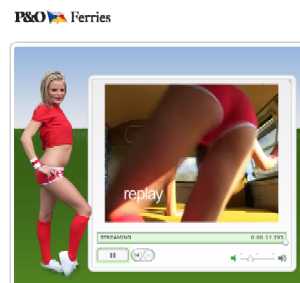
I was sent the viral Fan Van game this afternoon which (as chaps might be able to see) is quite an entertaining and visually appealing distraction. It has been sent on already and has therefore fulfilled the viral element of the strategy. What I'm not so clear on is how effective it will be at getting people to generate revenue for the company involved. That company is P&O and the strategy for this viral must be for (men) to enter the competition to win a van and therefore supply them with significant volumes of client data or book their trip (and I guess the supposition is that this will be a trip to Germany 2006 via the P&O ferry route) through them. I'm not convinced a high percentage of viewers of this viral will actually do that.

By chance today Justin Kirby of Digital Media Communications writes in NMA (New Media Age) about how "Marketers must get creative for viral campaigns to succeed". He asserts a similar position: "...sadly success still seems to be judged simply in terms of reach rather than tangible business benefits, such as shifting product or increasing brand advocacy." I'd like to see the figures from this P&O viral, what was their reach, what was the uptake in sales and what was the increase in brand awareness. There's no question that the P&O viral is creative, but does it have longevity? I might forward this on but I'll have forgotten about it tomorrow and it'll have been deleted from my mail box. It's not something I'm going to revisit and, if it wasn't for the fact I'm writing this, I'm pretty sure I'd have forgotten who it was for. In fact, I'd heard about it from a friend before I got the email ... he described it as "the fan in a van thing" ... I searched in Google for "fan in a van" and it didn't appear. I typed "faninavan".com and .co.uk, it didn't appear. If I had wanted to look for this after i'd deleted the email I wouldn't have found it again.

In addition, is this sort of viral just a little too indiscriminate. Some will inevitably fall on stoney ground. Ok, so it will reach a core target audience of 17-35 year old men but will all of these have the sort of disposable income where they will be booking P&O trips? Will they be the sort of chaps that will want a van? This seems a bit of a broad-brush approach. But then, does this wastage matter on the web. At the end of the day, you don't HAVE to click and a video of nubile girls is unlikely to annoy many unwitting recipients in this demographic. I'd have much more confidence in the product/service shifting results of this viral if it had been effectively targetted and profiled.

Some additional Blog comment via Gordon's Republic.

Technorati Tags: and


Prioritizing Dancing Mangos

It's been some time since I've posted about the dreadful service I have experienced on one railway. That's not to say it's improved, well not much, it's just that I seem to have bigger fish to fry.
However, I was delighted today to be pointed in the direction of Dancing Mango. I'm particularly interested in the Customer Experience section, I love reading about companies that are getting it right and those that are getting it wrong, it brings clarity to much of the internal hypothesising I find myself doing as part of my job. To that end it's been a real eye opener to pick up Jakob's new book, "Prioritizing Web Usability". Unlike some of his previous books this one (and it might be Hoa Loranger's input) contains a fair swathe of analytical, thought-provoking copy. But, and this is what give it credibility in my eyes, is that it's not afraid to say "we were wrong" or at least "we're no longer right" about certain topics. For example link colours. Previously Jakob said, blue is essential, now it's ok to use other colours for links as long as they're consistent and contrasting. Common sense prevails. It simply has less of a prescriptive tone and more of a common sense advice, and in that sense it picks up on the great successes of Steve Krug's work.

Technorati Tag :


13.5.06

Darling Buds of May (13th)


As mentioned previously I'm growing chilli plants this year. I thought I'd post a picture of my homegrown cayennes as they're pretty close to opening their first flowers. The macro shot to the left shows the buds are pretty abundant. My Habaneros on the other hand are a bit lacking ... more important chilli news later ...