3.11.05

The Customer Experience on One Railway (an open letter)

Following several earlier posts regarding my daily experiences with the woeful one railway, I decided after a difficult week to give the respondent and her team another chance....
"xxxx, you may know that we’ve corresponded in the past (ref: 143988) and, despite my better judgement, I have decided to give you all another chance to redeem yourselves with some superb customer service. You see I’m not really a complete novice when it comes to this sort of stuff. At work I live and breathe customer satisfaction, I’ve even been on the phones myself dealing direct with customers, that’s what makes my experiences with one all the more depressing – I know that it shouldn’t be that difficult to get it right.

I recently read a piece by Richard Branson, you know xxxxx, the one with the beard that’s got all those planes and trains? He said how proud he was that they’ve started to embed a culture of customer service amongst their staff, many of whom were embittered by years of pre-privatisation neglect. I genuinely hope that one are working this hard – from the very top of your organisation – to encourage such a helpful workforce. You know, I once heard a Chinese proverb which said “The man without a smile should never open a shop”, well, I hope you’re smiling.

Now, to the crux of the matter, every single day this week the 08:09 from Ipswich to Norwich has left Ipswich late. It does happen, I know, despite everyone’s best efforts, but every day this week? What makes is worse are two things (I’ll be nice and put them in bullet points so you can highlight them when you send the hard copy to your bosses)

:: The ‘due’ time on the departure boards kept increasing by a minute just as it ticked toward the latest time, so the train was due at 08:15, it got to 08:15 and suddenly it was due at 16, 17, 18 and so on.
:: There were never any announcements as to why each delay had occurred, what the estimates were for it to arrive, or what one were doing to help. Nothing, silence, just the received-pronunciation of your automated announcements.

What exactly do one want to sell me as a commuter? If your answer is ‘train travel’ or ‘a ticket from Ipswich to Norwich’ you’re wrong. What one should be offering is a journey experience. A visionary journey where the customer (passenger) is central to the experience. I want to wait for a punctual train at a clean, dry and comfortable station. I want to board a modern train, one that’s safe, reliable, fast, quiet, clean and superbly comfortable. I want every passenger to be paying a fare towards this service but a fare that makes sense. I want to be able to use a train toilet, read a newspaper, check my emails and get a coffee and croissant in the mornings. I want the conductor to be friendly, approachable, helpful and courteous. Is this what’s currently happening on one or is the reality more like this: I arrive at a cold, filthy run-down station to wait for a train that is always late but no-one ever tells me why. I sit down on a broken seat in old Virgin rolling stock amongst a pile of discarded papers and coffee cups. My ticket is glanced at by a bored bloke in his 40s but he ignores the kids opposite me with their feet on the seats who’ve not bought a ticket between them. We stop outside Diss for ten minutes where the heating breaks and no announcement is made, I await a refreshment trolley but one never comes. We move off and the knackered ex-Virgin carriages judder in to Norwich thirty minutes late.

These are not unreasonable observations; contrast the one London – Norwich service with:

:: On
GNER a month ago I travelled to York and surfed the web all the way there on my laptop through their onboard wireless service.
:: On
Virgin a few months ago I travelled to Manchester in blissful air-conditioned comfort listening to in-train entertainment and working on my laptop from the at-seat power point.
:: Grand Central Trains will not charge you if you have to stand.

So, some more questions for you and your colleagues to answer:

1. When will one provide new rolling stock OR rolling stock refurbished to a standard such as that seen on GNER’s flagship ‘
Mallard’ trains
2. What innovative changes to the service are one implementing to make their passenger experience exceptional, the sort of thing that makes people gasp (eg. wireless broadband)?
3. Why did one repaint Ipswich station in old Anglia colours during the summer?
4. Why does each ‘senior conductor’ provide different announcements when the train sets-off? Surely these should be consistent and meet basic Health And Safety requirements?
5. Why can you not find out the cost of an Ipswich – Norwich annual season ticket on the website (it only shows London season ticket prices) How difficult would it be to add an Annual Season Ticket check form where you input ‘from’ and ‘to’ click submit and it gives you a price?
6. Why do one not ALWAYS tell passengers why the delay has occurred and what they’re doing to resolve it?
7. Why are the ‘due’ indicators on the departure boards so inaccurate?
8. Why has the massive departure/arrivals board in Ipswich station foyer been broken for nearly a year? Is it THAT difficult to fix? (your website talks of investment in new passenger information systems… where?)
9. Why do one not use more (modern) matrix display screens along the platforms at their ‘rural’ stations?

xxxx, I don’t suppose you have all the answers, I don’t have the answers as to why our service is bad sometimes but I do know that we have a culture here of challenging this sort of rubbish. Knock on doors, speak to managers, pass this email round and get people to wake up to the fact that one are so far off the pace when it comes to customer service, innovation, progress and, quite frankly, the basics of providing a safe, efficient, reliable and comfortable service? Why not book a meeting with xxxx xxxxxx? Show him this letter, get him to call me. Are one serious about the customer experience?

The trouble is I have to use this service daily and in that respect it’s an easy target. You have to please me almost every day or I get upset. I get so upset I feel the need to complain only when I’ve endured a level of service that is woeful in the extreme, but that’s starting to be a daily occurrence.

31.10.05

Continental Fighting Lager™

Saw this expression used on Danny Wallace's Citizens Required 'census' for the nation of 'Lovely', have to say it perfectly represents a certain type of premium lager, ie. Stella Artois, 1664, Carlsberg Export, Grolsch etc. notorious for its high alcohol content, which has been linked to binge drinking. Probably been in use on the streets for some time but I wouldn't know.

28.10.05

A Grand Central Vision For Train Journeys

For the umpteenth time this week the 08:09 was delayed from Ipswich. One seem to make use of some kind of rolling update on their live departure boards. The ‘due’ time increases by one minute every time it gets to within 30 seconds of the train supposedly arriving. Intensely frustrating and, once again, there’s no mention over the PA system as to why the delay has occurred or what their doing about resolving it. I wish that train operators would introduce a bit more transparency and honesty into their customer experience.

One company [excuse the pun] that is doing something about the customer experience (or at least says it will) is newboy
Grand Central Trains. I have to say that I was quite fond of GNER through many experiences travelling to-from my alma mater but I would agree that competition on this line would be a good thing. Top of their customer-centric agenda (read: press release) has been the “Can’t Find A Seat? Have A Refund” message and, slightly lower on the agenda, a simplification of fares ensuring more customers pay lower fares.

I get the feeling that as the network infrastructure improves (it is isn’t it?) then rail companies are going to have to stop complaining about delays and service issues being out of their control and begin to provide the sort of experience that passengers have dreamed about for years. When Harley Davidson execs summarise “What we sell is the ability for a 43-year-old accountant to dress in black leather, ride through small towns and have people be afraid of him.” I have to wonder what ‘one’ and other customer-service-blind operators are really selling – are they selling an experience of effortless, productive and comfortable travel between clean, efficient and breath-taking stations? No, and this is the vision that they must strive to attain else we continue to endure something quite, quite different.

Avian Flu: Don't Panic Mr. Peters...

Somewhat irritatingly I’ve got myself into reading TomPeters.com again … he’s in Asia (or at least has been) at the moment and he’s got himself all worked up over bird flu. I must admit to, rather like the errant farmyard cockrel, sitting on the fence with this. Whilst I can see it makes sense to forward plan and perhaps move a few investments out of Asian markets in advance of any potential pandemic this does rather smack of American protectionism and the thought that anything that scaremongers amongst the fastest growing economies in the world will be good for the US market. At the moment it’s an Asian-European problem and I would imagine there are plenty of analysts on Wall Street who like it that way.

Anyway, if you’re interested in the more scientific monitoring of the spread of the virus, the BBC’s graphics department have produced a
blisteringly effective interactive map and timeline.

27.10.05

The Million Dollar Homepage

Every so often someone comes up with an idea so simple and so effective it causes you to sit back and applaud. On a big scale we’re talking about iPods, Innocent Smoothies, the Lotus Elise, Google …

Today I was told about one on a micro scale, a get rich quick scheme that is so much more innovative than the
pan-handle sites of a few years ago. The Million Dollar Homepage is a simple business model: get businesses to pay to advertise on space you own and will be viewed by many people. It was marketed in the best word-of-mouth style by a simple email campaign. In 3 days this guy had generated $400 (£223.80) in revenue. Frankly it’s money for old rope, but he saw the opportunity and did it. Tellingly there are close to 400 copycat sites itself an indication of the less inventive profiteering from others’ ideas. I only hope that these sites don’t take ‘trade’ from the original idea which, if it grows at current rates, should exceed the million dollar (£559,515.68) target by Boxing Day.

All those dead hours I spend dreaming of the Next Big Thing on the commute to Ipswich and this one had never occurred to me … nuts.

Kate Moss signs for QPR

UPDATED 22nd December with a link to Kate Moss in the Virgin Mobile Ad.
UPDATED 7th November with link to picture of Kate Moss in a QPR shirt


As an ill-disguised QPR fan (though they’ve been absent on this blog so far) I’ve had a good week. Thumping the Budgies at home was a sweet victory, taken in tandem with our mighty identical victory last season at Loftus Road against (then top-of-the-league) Ipswich means I’ve had plenty to crow about to the East Anglian masses at work for 12 months. I knew it would be an omen when I sat opposite Delia on the 17.30 to Ipswich last week.

Then along comes the news that Babyshambles frontman and outed coke-addict Pete
Doherty has written a tune about his beloved Rangers. I knew he was a long term fan and bordering obsessive about the club. Though I despise the chap and his nauseating music I have to say I am oddly tempted to gawp at the apparent picture of Kate Moss in a QPR shirt that adorns the sleeve notes of his latest release, Down in Albion. There’s something oddly appealing to the heterosexual male about a girl in a footy shirt, and for all her powder-snorting nonsense one can’t deny that Kate Moss makes good eye candy.

As for the ‘lyrics’ to Doherty’s QPR-orientated ode, the
Guardian reproduces them thus:

I'll be, I'll be there/And just before I hit the bar/With the ghost of Rodney Marsh in his pre-smug pundit days/ Before he sold Rangers down the Swanee/With Gerry Francis's offshore money/ It's a toss-up between Mick Jones/And a consortium from the Middle Eastern equivalent of Barrett Homes /I'll be, I'll be there/With blue and white ticker tape in my hair/Up the Rs/Up the Rs/Up the Rs/What a life on Mars.

The bitter sweet truth of the matter is that this song is unlikely to be used by the club or receive anything but a fans-only airing unless Rangers win the FA Cup. Which, frankly, is as unlikely as Doherty & Moss staying ‘clean’.

The BBC have a small summary article but have added some
cracking photos of the dysfunctional pair (Kate looking glam, Pete looking high).

This week Rangers face Derby.

26.10.05

Tom Peters, Bob Brown and Happy Eater


  • Took a look at a Tom Peters’ (Tom’s wiki biography | Tom’s weblog) book the other day. I nearly wept at how ‘groovy’ it was trying to be. The literary equivalent of a post-menopausal woman in white linen trousers and caked in St. Tropez. It’s impossible to read … you just observe the pages falling open in front of you. The actual content could have been presented more effectively if it had been painted in ink on glass underwater by a blind dog with a mop. If you want to try it for yourself, get RE-Imagine! from Amazon

Usability Issues With Blogging

Jakob finally gets round to writing a piece about blogs so I thought I’d better get round to blogging about it. I’m surprised it’s taken him this long frankly, perhaps he just thought that he’d covered most of it all before with his lists of things you shouldn’t do? So, to take arms against his sea of issues:

No Author Biogs
JN asserts that to post anonymously (or at least without a full biographical reference) is to erode the credibility of your comments and that users have a natural urge to know more about the writer. I’m not sure this is the case. I can think of several popular blogs that have no explicit author biography and are none the poorer for it. Do we really demand this sort of content? Is a contact email not sufficient if your inquisitive mind is not sated? JN assumes I suppose that everyone’s blogging about subjects they really ought to be qualified in. Along the same lines is ….

No Author Photo
Has he really thought this through? Does it really matter to the user if their readers can’t see who they are? Do we care, as consumers of literature, that we don’t really know what Shakespeare looked like or that our latest tome from Amazon didn’t have a mugshot of the author? Just because JN’s gurning mug is plastered in the NNg site in high-res (and interestingly only vaguely on his blog-like useit site) doesn’t mean I remember it more than anonymous blogs with a strong visual identity. In essence, I remember the look of a page/site, not the author’s face – a person I am highly unlikely to meet. Personally, keeping a photo off my blog has meant that I’m unlikely to see my face utilised for ‘inappropriate purposes’ by errant friends, colleagues associates and net weirdos.

Nondescript posting Titles
Is the joy of writing headline copy not the skill involved in capturing the essence of the story but in an intriguing manner. It might not always be obvious what the content will be but I would agree that it should tempt the reader to explore further. When seen a purely a link (ie. When the post has moved off the front page) it should remain as engaging and tempting as it did as a headline. In that sense, headline writing is indeed “the most important writing you do.”

Links Don’t Say Where They Go
JN’s missed a trick here. He could have praised the blog community for reviving the lost art of contextual linking. I see more contextual and descriptive hyperlinks amongst blogs than I do almost anywhere else. Bloggers, in their desperate hunt for more readers, have taken on board the benefits of using the sort of links that search engines love. Of course, there are still some of us that occasionally slip in the odd ‘click here’ or ‘more’, we’re human after all and sometimes, in the spirit of quick postings, it’s just not worth my while re-phrasing a paragraph to make a link descriptive.

Classic Hits Are Buried
Here JN is absolutely spot on. I for one know which posts are popular but I also know that they’re popular because people find them through Google and I don’t actually make reference to them that often in other postings. This is principally because I thought it bored people, regular readers, to keep hearing about the same stuff. I will, however, reference the most popular posts in a sticky link in the right menu as it can’t hurt and might actually make new visitors instantly discover worthwhile wheat amongst my blogging chaff.

Calendrical Navigation Is Rubbish
I would have to agree here too. I so often come across blogs when googling for subjects only to click on them and find the relevant post missing. A search using the native tool is regularly ineffectual and you have no idea where to start clicking through dates to find stuff. This blog is constrained by the fact that it’s a generic blogger-powered one and therefore can’t do categories. Believe me, if I had the technical nouse I would have added a better archival system and navigation months ago. I blame Blogger. (BTW: Some other people have discussed calendrical blog archiving)

Irregular Publishing Frequency
This is like people telling Wayne Rooney to calm down. It’s simply the nature of blogging that it will be infrequent. In its purest form blogging represents the erratic ramblings of web-connected individuals, capturing thoughts, moments and experiences online. In the same way that it’s unrealistic to expect them to have biographies and high-res press photos, it’s unrealistic to expect them to stick to defined publishing schedules (a la Alertbox). It’s enjoyable, in a frustrating way, to await the arrival of a new posting from a blogger you’re interested in. I would not want to dictate to people when that should be posting. The benefits of RSS feed readers is that they notify you when posts are updated and this usually is a damn site quicker than traditional web pages.

With this in mind, to tell people not to post if they having nothing to say is for others’ to make judgement on the worthiness of the articles and to my mind that’s a bit wrong. A blog will, inevitably, contain a bit of rubbish every now and then. In many ways it makes the better (more worthy) content stand out more.

Mixing Topics
A subject close to my heart. I mix content all the time. Some customer service, some user-centric web development, cars, holidays, one anglia, Taco Bell, politics, economics etc. etc. As long as there’s an even thread in the blog – in my case customer/user-centred thinking – then it’s ok in my book. People like a bit of irreverence. Granted, if you set a site up like useit then it’s going to seem odd if Jakob starts talking about his dog, his problems with public transport or the economic policy of China but in most public blogs the joy is figuring the connections between the apparently disconnected. Finding out a little about the character behind the writing – without being spoon-fed such information in the biography (vide supra)

Forgetting That You Write For Your Future Boss
Ok, so the web is persistent. I find stuff on there all the time that should have expired a long time ago. I find some stuff on my blog which I’m a bit ashamed about (see Katrina ramblings) but it’s going to stay. I’d not be stupid enough to expose myself to legal action or severe controversy as I know my current boss reads it. Bear that in mind and keep some perspective (bosses are human too) and I can write to my heart’s content. I am naturally cautious about appearing ‘expert’ – especially on topics I’ve only ever really dealt with academically – but people are still visiting you site for analysis, though and consideration. If you shy away from forming opinions then you really are saying nothing at all. As a future boss I’d find that a little sad and vacuous.

Having A Domain Owned By a Weblog Service
… i.e. blogger. Well, apart from expense, blogger got me online in minutes and has supported pretty much all of what I wanted to do – except category archiving. We can’t all afford servers, hosting or spend the time setting up MovableType, PHP, MySQL etc. etc. As far as I can tell, blogger keeps advertising away and has ensured that I’m instantly part of a major blogging community – all for nothing. I’d love to move to my own server and I accept JN’s argument that the longer I leave it the harder it will be so if he wants to sponsor my move to a standalone site could he let me know?

Technorati :

24.10.05

2 Fascists: Saddam Hussein and a non-compliant vending machine

Two things today, firstly something political: A great piece by John Simpson about the trial of Saddam Hussein where he muses over SH’s potential to become a martyr, the evidence the prosecution may present and some of SH’s possible lines of defence.

Secondly, a wry observation on the very essence of HCI. I tried to get my usual vending machine coffee today (two 58s with the cup dispensing overridden to dispense into a mug) but the machine displayed: “Sorry No Cups”. I thought this wouldn’t matter, I’ve got my own mug, It’ll still dispense my usual cup-free option … not so. No cups mean no fluid whatsoever. It really doesn’t want to play if there are no cups. Ridiculous. A system blockage preventing a very plausible human interaction but one that vividly illustrates a neglect of user-centred design.

14.10.05

UCD vs. SEO - responses

Following my blog posting (and email to uk-usability) regarding search engine optimisation (SEO) and user-centric design I have had some thoughtful emails and just wanted to take the opportunity to respond to a selection of the issues raised.

‘Looking for’ vs. ‘expecting to find’
There is an argument that these are one and the same, that people search for what they want to find on the page, but is this always the case. Anecdotally I know I often search for things in Google when I don’t really know what I’m searching for … today, for example I searched for “networked external storage” but when the results came up and I clicked on one I realised I should have been looking for “ethernet ide drives”. Alastair Campbell of
nomensa also mentioned this frustration when searching in an area who’s terminology is unfamiliar. Site developers thus need to consider not just what their page contains but the quite different ways in which people may look for that content.

A similar frustration was cited by Lola (from Agency.com) – the effect of being dumped on a landing page rather than directly at the point where the searched-for content resides: “if I search for something the last place I’d want to land on is the home page or some other page where I have to navigate and think a bi more to find the info I want” … and earlier “when a user comes to your site intent on finding a keyword she has in mind, you’ll be meeting her needs more readily if her keyword is easy to spot”. I have found the Google bar ‘highlight keywords’ feature invaluable in this instance.

The Team Issue
My original post was concerned with whether putting the SEO team and content development teams together was counterproductive. Ashley, CEO of
e-consultancy asserts that we need to “achieve the optimal balance of what is right for the user AND the search engine” and in this regard “usability people need to understand SEO better and SEO people need to understand UCD better” which is a pretty decent summary and points at a collaborative blend of skills.

Ashley also exposed my naivety in terms of the way that spiders actually work (and thus indicated my need to work closer with spider-savvy SEO colleagues) by informing me that they actually “try to be as human-like as possible”.

Other SEO and usability mutual benefits can be seen by taking a look at “
What’s good for the search engines AND good for the user?” and the more recent (but broader in scope) “From paper to page – what’s the ideal web design process?”. Both of these articles were produced by Ashley.

Many thanks for everyone’s responses to the question.

Technorati :

12.10.05

iPod video


The rumours were right, an iPod video, the long-awaited enhancement to the 'daddy' iPod (i.e. not the Nano which replaced the mini iPod ... got that? right :) ) In the UK we'll pay £219 for the 30GB version (black or white) and £299 for the 60GB version (again, black or white). These prices are direct from Apple's UK store iTunes 6 is to be released though I suspect this will benefit US consumers primarily with its movie and TV download capability. There's a new iMac too, you might as well read about that on the official site. See my earlier posting for other sites with full details of the announcements today.


I'm not sure where Apple go from here. The iPod is about as functional as it could be now. Only revisions that keep it in the portable media device and not a mini personal computer are reductions in size and increases in capacity - specifically in solid-state memory. Even so, the 15,000 song capacity that the 60GB version now achieves represents most people's entire music library so capacity has an effective consumer limit if not a physical one.

I suppose the innovations now start with the Intel-chipped Macs but as rival manufacturers charge to introduce their own portable video media players Apple will have to be careful to continue with appropriate bold innovations in their flagship device in order to avoid dropping the ball that has so far seen them achieve their most impressive financial results in the company's history.

Search Engine Optimisation: Increased Usability?

A simple question, does search engine optimisation (SEO) improve usability? [a later post with answers is now available]

The reason I ask is that I’ve just been hearing some arguments for restructuring a team to include the SEO guys in the initial content authoring stage to clear the blockage that occurs when content is written and then sent to SEO for amendment. My fear is that if this is taken too literally, that copy on pages resembles the most appropriate for SEO but doesn’t actually work as effectively for the user. Effectively the pages become a long list of keywords and we return, in part, to the days where everyone buried ‘Britney Spears’ in the footer of their pages to score more hits.

In Trenton Moss’ article he asserts that “write your site’s content using the keywords for which users search and you’ll literally be speaking the same language as your visitors”. Well, technically yes you will but most people’s search terms do not reflect good copy. It should be the case, should it not, that search engines reflect the content of the pages they index, not the other way round? Writing page content that engages the user and speaks their language should not be borne out of a need to fit within Google’s requirements but rather a need to fit the users’ requirements.

I accept that other elements of his article ring true, page sizes, CSS in place of tables, descriptive links (a real passion of mine and something which blogging and hypertext rich experiences such as Wikipedia has bought back to life).

However, his last point, ‘Provide Quality Content’ is exactly why I would not like to see the team structured around SEOs. Again we need not to satisfy the SEO drum-beaters but to satisfy the users. To my mind this can only be done by experienced copywriters and people with a genuine nose for what visitors want from a site, people who tested, questioned and researched the user community. So, by all means keep an SEO check at the end of the process but don’t consider it the foundation on which to build a page, right?

[this item has been shared with mailing list uk-usability]

iPod Video Launched today?


Very excited today. More than I should be. A friend alerted me to Mac Rumors (sic) which I have browsed in the past but since the Nano had just been released I'd assumed Apple had played its cards for Q4 2005. Then this rumour appears about "One more thing..." and the visual effect of movie theatre curtains suggests a iPod video with associated iVideo database to download films, TV shows etc. Of course, this is all speculation but this blog reports a significant video blog site has been asked to be part of the presentation.
It all takes place at 10am EST (18:00hrs BST) in San Jose and I for one will be scouring the net this evening to obtain news.
Having just announced their best year ever, Apple are in the ascendant and whilst many would want the delivery of new Power PC versions of the G5 and PowerBook before the switch to Intel chips, I believe that the best people to steer Apple to even greater heights are already in Apple HQ (ASIDE: interesting articles about MSN removing the Apple building at Cupertino from their maps and another one refuting that suggestion)

Technorati tag:

Update: This blog will probably have the news ahead of me... Nick Starr seems to be covering the rumors comprehensively

11.10.05

Driving in Greece

I am aware of course that this blog is turning into something quite different from the intended eloquent and considered analysis of web usability but I do have some hope that (due to forthcoming changes in my career) there may be scope to return to these subjects later. In the meantime I find it enjoyable to sit and write about subjects which continue to capture my imagination. And what better place to start than with Greek driving?

Of course this is borne out of my recent driving experience on Samos but a timely article in the Saturday Telegraph has put it firmly on my blog agenda. I feel I should declare an interest, my long-suffering fiancée is half Greek and thus blessed with the temperament of the warm bloodied Mediterranean but, being a British learner driver, she is likewise blessed with a healthy terror of the British driving experience. As a passenger in our rented (and dented) saloon Megane, she found herself looking not so much at the mountain scenery as crossing herself and squirming as we forcibly took another switchback hairpin on the wrong side of the road.

You see the problems are two, three, maybe even fourfold. The fabric of the roads is dire, the presence of road signs and signals erratic, drivers’ obedience to them non-existent and finally, the drivers are under-skilled and fearless. Of course, this is not to imply that us phlegmatic Brits are the pariahs of cautious driving or indeed that our road etiquette is exemplary, far from it, merely that judged by Greek standards one has more of a chance over here than we do over there.

In anticipation of the poor state of the islands roads, I requested Europcar provide us with their smallest runabout, the intention being that this would provide the best visibility and manoeuvrability on mountain switchbacks and through town. When on holiday I’m never really in a rush so a 1 litre engine is fine, if it takes all day to climb up the mountain, so be it. I’d rather have that than be in a 2 litre wide-bodied saloon (sedan) when a coach comes round a blind bend. When I ended up with the free upgrade to the Megane I was miffed rather than delighted.

What amazes me most about driving in Greece is the propensity to overtake where there is no conceivable benefit in terms of time and where the current conditions (blind bend, up hill, driving rain, oncoming traffic etc.) would suggest the only possible outcome is to end up as another shrine and cross on the side of the road. These little shrines are abundant on the roadside, a regular reminder of those that didn’t fare well on the Hellenic highways.

Author of the article Essex University professor Anthony King talks of the white lines painted ostensibly at the edge of the road. In Samos even these are a rare sight. After a ferocious downpour we ventured into the island up the principle roads from Ireon to Mitilini. It was littered with boulders and the previously indistinct tarmac edge had all but disappeared under a sea of red earth and rocks. We did see earth movers scraping some of it back to the edge but you just knew that this was a token gesture and after a few hours the job would be considered complete.

We had been out during this storm, visiting the ancient temple of Hera just outside Ireon and on the desperate limp back to Pythagorio in the downpour I was lit up like a Christmas tree with dipped headlights and fog lamps. In front was a rusty pick-up, in the middle of the road (avoiding puddles) with no lights. Despite being no more than 20 metres in front I was barely able to see him as he swerved right to avoid oncoming traffic and veered left to return to the centre again. He’d have been safer if he’d have driven blindfolded I’m sure. People talk of European standardisation and harmonisation yet in Denmark and Sweden cars have permanent sidelights on by law and in Greece no-one will turn their lights on unless the sun has set?

It’s comforting to know I’m not alone. In the land where one can (as we did) see a standard Daewoo Lacetti cruising the strip with vinyl lettering all over the side and Sakis Rouvas blaring from the stereo, many of us Brits are clearly terrified of driving. 50% of Britons who have driven in Greece describe the standard of driving as poor or very poor. Interestingly, the problem is not one of speed. The Greeks, on the whole, drive relatively slowly - the recklessness comes from people overtaking between 40 and 60 mph to gain one car length. Given that most island drivers are driving heavy old cars with engines under 2 litres on roads like the surface of the moon, this is unsurprising.

Interestingly the YouGov poll, to which the Telegraph article refers, omits Portugal, India, Morocco, Egypt and others meaning that the Greeks may yet have to settle for a (posthumous) bronze in the Olympic sport of dangerous driving.

For all the criticism, here is some practical advice for driving in the Hellenes.

7.10.05

Back from Samos

Finally got round to reading Mitch Albom’s ‘Five People You Meet in Heaven’ , a recommendation by one of my directors at work and it proved to be an eminently digestible and, ahem, spiritual book. I have read reviews of it which describe it as slushy Hallmarkesque sentimental nonsense and I would agree that it walks a very fine line between schmaltz and thoughtful prose. The premise is that, upon our death we meet five people on a journey to heaven that make sense of our previously physical life. (I can hear people beginning to make moves to navigate off this blog already.) If you read it expecting it to be crap sentimental rubbish you might find yourself surprised, if you’re expecting an inspirational cerebral analysis of theological and spiritual exploration you’ll be disappointed. It was perfect for a sunny couple of days poolside and I found myself thinking about its themes for days afterwards (and will continue to). I am resolved to read Mitch’s first book ‘Tuesdays with Morrie’ in an equally relaxed frame of mind. Please do give it a few moments of your reading life.

Aside from that I tried to re-read ‘The Moral Animal’ but gave up (I didn’t want to think too much in between Fanta Lemon and UV-roasting my dermis), but did tuck into Steven Johnsons ‘Everything Bad is Good for You’ and finish the last chapter of ‘The Essential Difference’ which I had somehow neglected. As far as I’ve got with Steven Johnsons’ book I’m quite impressed. It’s a little weak on the empirical psychology (and I doubt this improves in later chapters) but provides a compelling alternative to the negative column inches that so-called ‘dumbing down’ occupies in the popular press.

I missed two things whilst abroad: Earl Grey and Lost. I gained a peculiar interest in beach volleyball, regained my enjoyment of gym workouts and developed a huge chip on my shoulder about being unable to speak much more than a few words in Spanish, Greek, German, French and Italian especially when our Italian animation chums Alberto and Fabio seemed to speak five languages to conversational level. On the plus side, I only came back to 55 emails at work and 70 at home.

Now, some quick questions: Why don’t the Greeks seem to finish buildings? Everywhere you look there are empty concrete shells or houses with reinforcement rods protruding from the upper floors [answer: see below]. What are the advertising criteria for BBC World? It seems to be one of three things: airlines, national tourist boards or energy companies. Finally, why should one have to pay to use a safety deposit box for two weeks? What cost does a hotel incur for the use of such a box on a daily basis? Surely a deposit for the key is enough?

The sum total of my greek vocab: kalimera (good morning), - spera (afternoon) and nihxta (night), parakolo (please), efharisto (thanks), the numbers 1-10, endaxi (ok), neh (yes), oghi (no), signomi (sorry, excuse me), nero (water), malaka (wanker etc.), spasta mutra (I’m not really sure… but I think it’s something like ‘shut up’).

Why the Greeks don’t finish buildings:
The Greeks often build what they need for the moment and leave the rest of the building unfinished for completion some time in the future. Breaks in the building schedule may therefore be either scheduled, bureaucratic or financial – possibly all three! Greeks are constantly building over long-terms: a significant reason for this is that parents build houses for each daughter, (sons are intended to marry a girl who’s got a house from her parents having had one built or passed to them through inheritance). There is a bit of a myth about taxes only being levied when the roof is added hence the proliferation of iron rods exposed from the tops of buildings ostensibly ‘unfinished’ but this is simply not true.

19.9.05

John Is On Holiday


I know it's been a while but I'm on holiday now. I have departed to the shores of the (as yet) unspoilt island of Samos in Greece.

Various jealousy-inducing links:
The hotel apparently has an 'internet corner' so I might be able to submit the odd blog entry and post some pictures to Flickr. In any event, I look forward to blogging when I get back. Cheerio,

John.

PS. If anyone wants to send me an iPod nano to celebrate my birthday (which was on the 10th September) then contact me through my website.

PPS. If you need something to stave off the boredom in the meantime, check out Steve Job's Special Event webcast ... some really entertaining stuff.

9.9.05

Ashes, Dyslexia, Countryside, Moyles, Robbie Williams & BMW 130i M Sport

Cricket
Good-ish start yesterday to the final Ashes test. I’ve never been a cricket buff, maintained an interest since school and always been a bit envious of people, like baseball nuts in the US, who are able to quote stats and talk comprehensively and insightfully about cover drives, reverse swing and silly mid-off. For my part I love the drama and tension of a four-day sporting occasion played out under English sunshine, somewhat more engaging than a petulant over-paid teenager getting narked at Windsor Park in Belfast

In terms of keeping up to date I have tried both theirs and the BBC’s I’m happiest with Channel 4’s Desktop Scorebox.

Dyslexia
Delighted to see Professor Maggie Snowling on TV last night in the Dispatches programme which re-evaluated our understanding of dyslexia. Professor Snowling is a specialist in child linguistic development at my alma mater, the University of York. For many years I’ve believed (anecdotally I must add) that dyslexia was over-diagnosed and misunderstood by psychologists, education professionals and parents. Last night’s programme presented a raft of evidence, collated over many years and studied by the foremost centres of Psychology at York and Durham that essentially presented dyslexia as a condition that has some genetic basis but is significantly exacerbated by developmental problems. They continued to debunk the myth that dyslexia is an intelligence issue but, most importantly, they identified a shocking failure in traditional therapeutic responses to this wide-ranging condition. Essentially there have been limited improvements in childhood literacy despite massive amounts of investment. Fortunately there is now a proven and robust way of educating and improving individuals with dyslexic-type problems – though it is used only in Cumbria and North Yorkshire.

There continues to be a hot debate on this subject and the anxiety felt by parents and teachers at being told that our understanding and treatment of dyslexia is misguided must not be underestimated. Taking this into consideration I feel considerable pride at having been educated under Professor Snowling and her colleagues in the Psychology department at York, particularly because they have not simply identified a problem and shortcomings, but have proposed, developed and proven an alternative. British education policy-makers should stop blindly issuing laptops and extra time in exams (of which they have kept no record) and sit up and listen to this evidence.

Countryside
BBC’s effervescent Breakfast News programme this morning spoke to a chap who was attempting to counter the CPRE’s assertion that we’re losing more and more countryside to unnecessary development. This bullish individual (whose name I forgot to note down) maintained that this was simply an attempt by “posh people” to protect “their own back yards”. Why do people like this continue to believe that the countryside is populated by Posh Toffs in country estates? Liberal middle-class Blairite metro urbanites in their deluded world fail to see the rural hardship, the modest dwellings and the dwindling community social structure in the countryside despite scouring the papers to purchase second homes and price out the very people they now claim are looking for affordable housing which should be built on greenbelt land. In his impassioned rant he maintained that a massive proportion of land was still green and much of it assuredly protected by greenbelt and AONB designations. This seems to have no basis in fact. Such designations have not prevented the development of thousands of houses in the South East following Prescott’s demands to build all over Kent.

What needs to happen (alongside my theories for the return to sustainable high-quality agriculture) is development like that taking place in Ipswich. A run-down industrial dock area is being transformed (the demolition teams started work this week on the Cranfields Flour Mill for Wharfside Regeneration’s major project) into a mix of affordable and luxury development. There are thousands of acres of undeveloped brownfield sites across the UK which would serve the needs without desecrating more countryside. The countryside is not, as this chap seemed to believe, simply a place to look at and take walks in. It provides, broadly, food, forestry, oxygen and sanctity. It is, in short essential.

Whilst on the theme of development, I see from local papers that Sittingbourne (subject of recent disparaging comments from David Baddiel) are considering plans for a major new development away from the High Street or in the woefully neglected Forum centre. In a town centre which has already see independent butchers, fishmongers and other such stores close in recent years as a result of a supermarket invasion, why would planners consider anything other than re-developing a centrally located shopping mall to attract major national brand interest? This, combined with an effective strategy to encourage quality local independent traders would encourage people to visit the town again. What the town does not need is a major new supermarket in the middle distance drawing people in cars away from the traditional heart of the place. Another supermarket, even one like Tesco, will encourage nothing other than more generic stores already very well represented in Maidstone, the Medway Towns and Bluewater.

Moyles
Have been amused by Moyles’ ongoing campaign to Say No To Wogan. However I’d like to hear Wogan’s reaction but listening to two stations is, if not impossible, wholly impractical. Might be best to get a bit of Wogan during the week and listen to the Best of Moyles Podcast on Thursdays…

Robbie Williams
New single, “Tripping” I think, is excellent. Didn’t like Radio (but appreciated the post-Chambers change in direction) but this one is brave and different again. He might not get the perma-tanned 30 something’s weak at the knees anymore in the same way Angels did but he knows his audience better than his critics do. His recent (vaguely bitter) handling of a press conference showed a greater intelligence than many might give him credit for.

Other stuff I’ve been listening to: Shakespeare Sister and P J Harvey, makes a change to get some thoughtful lyrics through my headphones. Steve Wright in the afternoon has made a change too, I’ve not listened to him since he was on Radio 1 – and this show is very similar – but I think the repetitive nature of it means that it’s only worth listening to on two or three days a week.

BMW 1 Series
A new 1 series M Sport version has been announced. Not technically an M1 but more an improved petrol range-topper with a bit of an M-range styling makeover. As Andrew Frankel pointed out in the Sunday Times Driving supplement though you could get a 330i for £2,310 more which seems to make more sense. I’m prepared for BMW to lend me one to change my mind though. Get in touch BMW UK …

5.9.05

International Arrivals

Neglected to add international visitors:

  • Forty visits: USA

  • Four visits: Canada

  • Three visits: Germany, Netherlands

  • Two visits: Australia, Denmark, Singapore, Malaysia, Spain, Sweden, Belgium

  • One visit Portugal, Taiwan, Nepal, Switzerland, Hong Kong, Argentina, Slovenia, France, Philippines.

3.9.05

Humble Pie

Sometimes you have to eat humble pie. Last night as I travelled down to Hampshire in what must have been one of the most delayed motorway excursions I’ve ever had, I had the fortune to be listening to various BBC radio reports about New Orleans. Coupled with a flick through the paper on the train back from Norwich that evening, I began to realise that yesterday’s post on the situation there was bordering on the offensively naïve.

In the same way that the world has had to re-asses America’s political integrity and foreign policy in the wake of the disasterous ‘occupation’ of Iraq, so we are having to re-asses America’s socio-democratic integrity following the scenes of physical and social devastation in the flooded Southern States.

How can it be that this beacon of global development, the “land of the free and the home of the brave”, sends National Guardsmen to randomly drop water supplies on citizens and let an anarchic mob control the distribution? How can rows of gun-toting soldiers stand by in silence and inaction as scores of desperate people are jostled, anxious and confused in conditions of mediaeval squalor? I simply do not understand how this stellar country has failed to prepare adequately for such a well-forecast disaster. School buses, for example, remained un-moved when they could so easily have been used to ferry the impoverished and infirm from the danger zone.

I read also of the elderly, abandoned and dying in wheelchairs. A conference centre packed with people of all ages expiring through neglect, whilst across town the Superdome is terrorised by armed and violent gangs who are raping and beating fellow citizens, all the while the World’s cameras buzz overhead.

I (often wrongly) draw comparsions with our own country. What if Manchester was plunged into similar circumstances? Would the notrious gangs of Salford be so violent, disrespectful and armed with guns? Would efforts to bring law-and-order by our police and servicemen be met with similar armed resistance? Would our troops, famous for their ‘hearts and minds’ approach, be successful with that strategy or would they too fail to distribute aid with any sense of priority? My belief is that this would not be the case and the American response is a simple reflection of the proliferation of guns and a misguided notion that this heavily evangelical region is a community with unquestionable Christian morality and integrity.

The situation in the southern states (ironically as it was in post-invasion Iraq) has been handled abysmally. Hindsight is indeed a wonderful thing and it is easy to criticise from a distance but the facts remain. The majority of the wealthy and the able escaped the city. The poor and infirm were trapped. Officials knew for some time the threat Katrina posed and provision was made with neither time nor skill, to evacuate the city comprehensively. It is obvious (and accepted by the gorvenment) that relief was too slow, too disorganised and did not consider the security situation.

America needs to wake-up quickly. On the one hand we said America was too insular and needed to think global to address foreign policy. Now Americans will be wondering how it is troops can invade a country but can’t prevent anarchy in their own backyard. Whether the country is introspective or has Imperial aspirations it seems to approach both inadequately. Things have to change and it’s unbearable to think that this Administration has just secured “Four More Years”.

But now is not the time to pass judgement, it is time to put aside objections about policy. America, so often first to help, needs the world’s attention and comprehensive assistance. Britain should contribute in money and in manpower. Those who say otherwise must consider whether this would be forthcoming were the reverse to be true. The answer is “of course it would”.

  • Here's a blog from the 'Eye Of The Storm' which is somewhat better at reflecting the conditions than I am

2.9.05

Katrina's Wake: A Humanitarian Disaster?


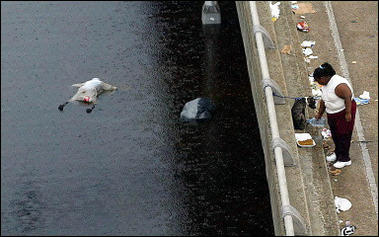
A body floats in floodwater in New Orleans(image from Flickr)


I’ve got a page in my FiloFax which is filled with Blog topics but Katrina is begging to be discussed. As most armchair-analysts do, I have spent the last few days watching the footage on TV and passing ill-informed comment. My initial reactions were “they shouldn’t have stayed, it’s their own fault”, “looters are scum, there’s no excuse”, “the Authorities are doing all they can” and so on.

It transpires that, despite being given plenty of days notice, many of these people – predominantly black ‘African Americans’ - couldn’t escape the city. The cost and logistics of public transport meaning that options were limited. I’m not sure how much of this I believe. Everyone in America has a car and gas costs less than Pepsi. If you couldn’t get out, you must have known someone who could and would. The reasons people have stayed therefore are multi-faceted.

» A belief that the storm wasn’t as serious as officials predicted.
» The assumption that it would be 48hrs of wind and rain – not that the levees would break and cut them off.
» To protect property from looting (a popular view, easily proposed with hindsight)
» Infirm, old, disabled or incapacitated in any way.

Whatever their reasons, a proportion did stay and the dramatic scenes on TV and documented on
Flickr show the fragility of the society they created. In particular the result of their impoverished layer of society. I can’t assume that middle-class educated citizens would behave differently of course but in the absence of any comparison scenario I am unable to see these events as anything other than the product of an ill-educated strata of society that has always been living perilously close to anarchy.The actions of looters are deplorable aren’t they? Where does one cross the line though? Is breaking a shop window to get to food and water looting? Is it material gain or a simple act of subsistence? Are property rights sacrosanct in such an environment? I would say that taking anything other than that essential for human survival is looting, the media is debating this furiously. The images of dreadlocked men floating out of supermarkets with beer cannot be excusable on any level. However, is this another race issue. Does it matter if the “looter” is black or white (alternative interpretations of that picture)?


A hungry survivor? Or a starving survivor? You decide…

People are sitting there on TV sobbing and screaming about people suffering from hunger when they’ve not eaten a full meal for all of 48hrs. These are people used to (albeit nutritionally-poor) above average amounts of food on a daily basis, any enforced fasting is going to seem like a big deal. People aren’t likely to go un-rescued for anything longer than 3-4 days, whilst very very difficult for people this is hardly a case of people dying of malnutrition. I saw one guy, about 230lbs, in a clean white t-shirt waving his hands at the camera pleading starvation, I may be cynical but this guy is hungry having not eaten for a few days, not starving. Given that a film crew got in, he can get out.

To finish I accept the situation is critical, deplorable even. But it is not a humanitarian disaster in the same way that the Asian Tsunami was, or the Sudan is. This is America, the media love images of gun-toting looters and the distressed public and this is what we’re being fed. In less than 24 hours the

Superdome will be cleared, the choppers will have deposited enough guardsmen to enforce law and order and people will begin to focus on what’s really important in New Orleans – whether there’ll be Mardi Gras.